
A reception in May 2026 celebrated the legacy of the late Justice Ruth Bader Ginsburg and the fund named in her honor at the ABF.
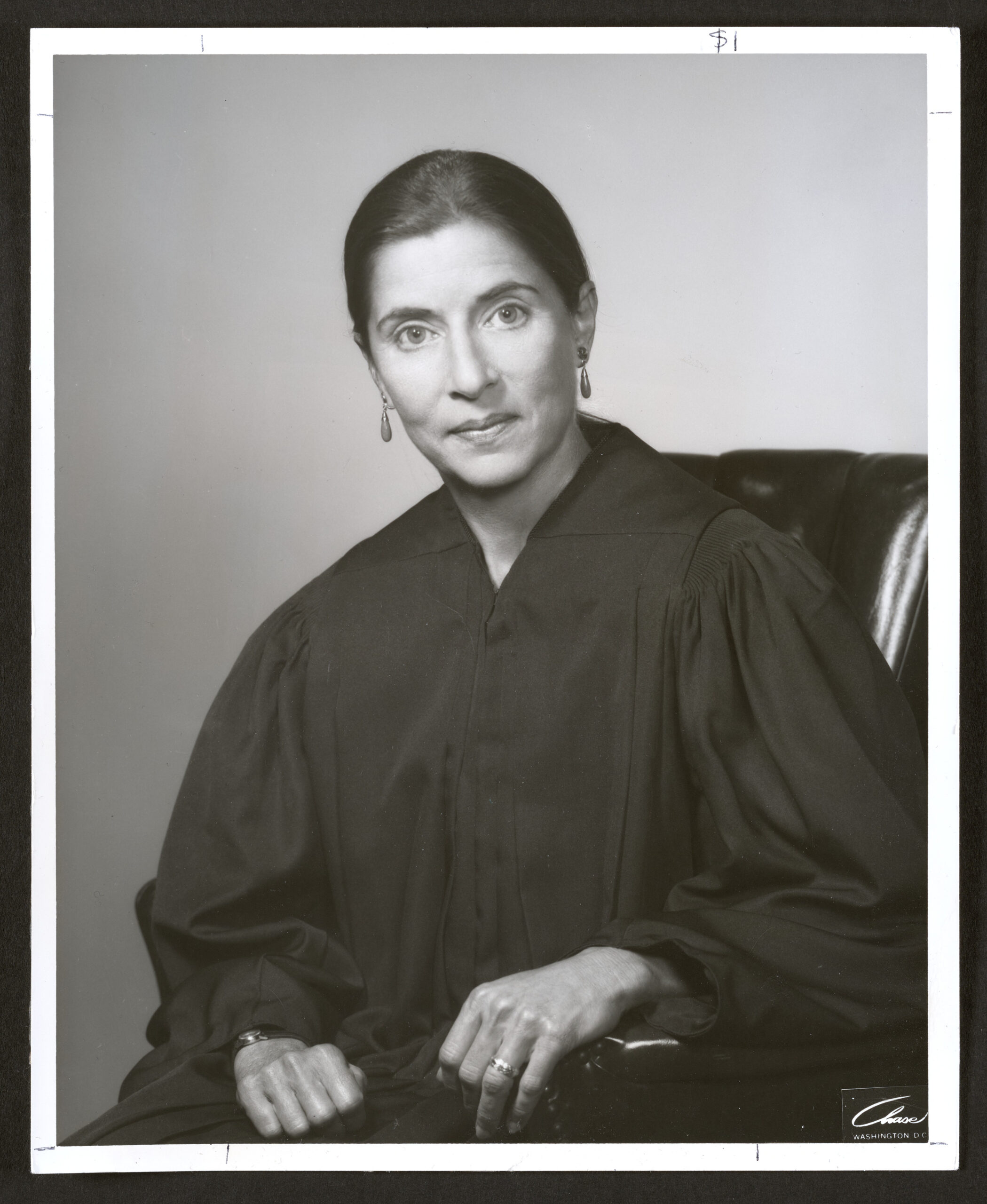
When Justice Ruth Bader Ginsburg entered Harvard law school, she was one of only nine women in a class of 500 students. Women were largely excluded from the legal profession at the time, and Ginsburg faced the doubts, exclusion, and prejudices from others in her field as she built her career in law. She overcame immense obstacles to become the second woman and first Jewish woman to be appointed to the US Supreme Court in 1993.
Ginsburg didn’t just overcome discrimination to ensure her own success; she advocated against sex discrimination throughout her career, creating opportunities for women and men to choose their careers and lifestyles more freely. Her example inspired a generation of civil rights lawyers, and she left an indelible impact on the law and American life.
The American Bar Foundation launched the Ruth Bader Ginsburg Endowed Fund for Research in Civil Rights and Gender Equality (the RBG Fund) in 2021, following Ginsburg’s passing in 2020. The fund pays tribute to Ginsburg’s legacy and honors her contributions to the ABF’s work.
Ginsburg was a steadfast supporter of the ABF throughout her life. She was a Patron Fellow and served as an officer on the ABF Board for more than a decade, holding the position of board secretary for many years. In 1995, Ginsburg received the Fellows Annual Award for Outstanding Research in Law and Government from the American Bar Association. As a tribute to her legacy, the RBG Fund seeks to build an endowment to support research and programing focused on civil rights and gender equality.
A Legacy of “Rigorous Questioning”
While Ginsburg began her legal studies at Harvard, she later transferred to Columbia Law School, graduating in 1959. Years later, in 1972, she became the first woman to serve as a tenured law professor at Columbia. It was the same year Ginsburg joined the ACLU as the founding director of the Women’s Rights Project.
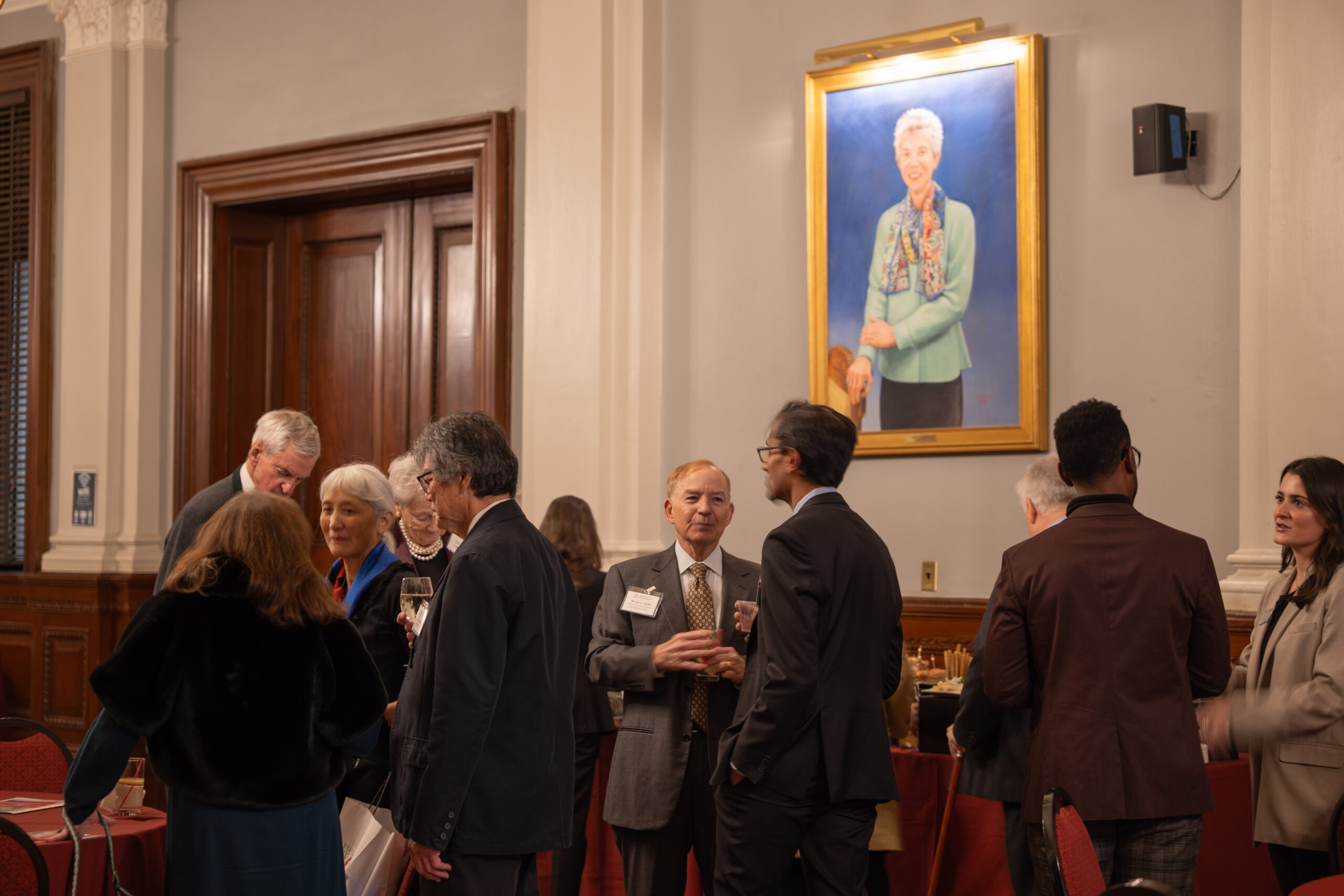
Ginsburg had already made an impact as a volunteer with the ACLU: She wrote a brief in the important Reed v. Reed case in which the Supreme Court, for the first time, struck down a law for treating men and women differently. Ginsburg was involved in thirty-four Supreme Court cases during her time with the ACLU, advocating against sex discrimination through a carefully planned litigation strategy that approached sex discrimination as an issue effecting men as well as women.
Ginsburg left the ACLU in 1980 to become a judge on the US Court of Appeals. In 1993, she was nominated to the Supreme Court by Bill Clinton. Ginsburg continued to be an advocate against sex discrimination from the bench and in public conversations about the law. Countless people have been inspired by her contributions to gender equality and her perseverance against discrimination throughout her own career.
This is the legacy that the Ruth Bader Ginsburg Endowed Fund aims to honor by supporting research that promotes a more just and equal society. Since its founding, the RBG Fund has held events in Chicago, Washington, DC, and Los Angeles. Most recently, supporters of the fund convened at the New York City Bar Association in Manhattan to celebrate Ginsburg and her legacy in the city where her legal career began.
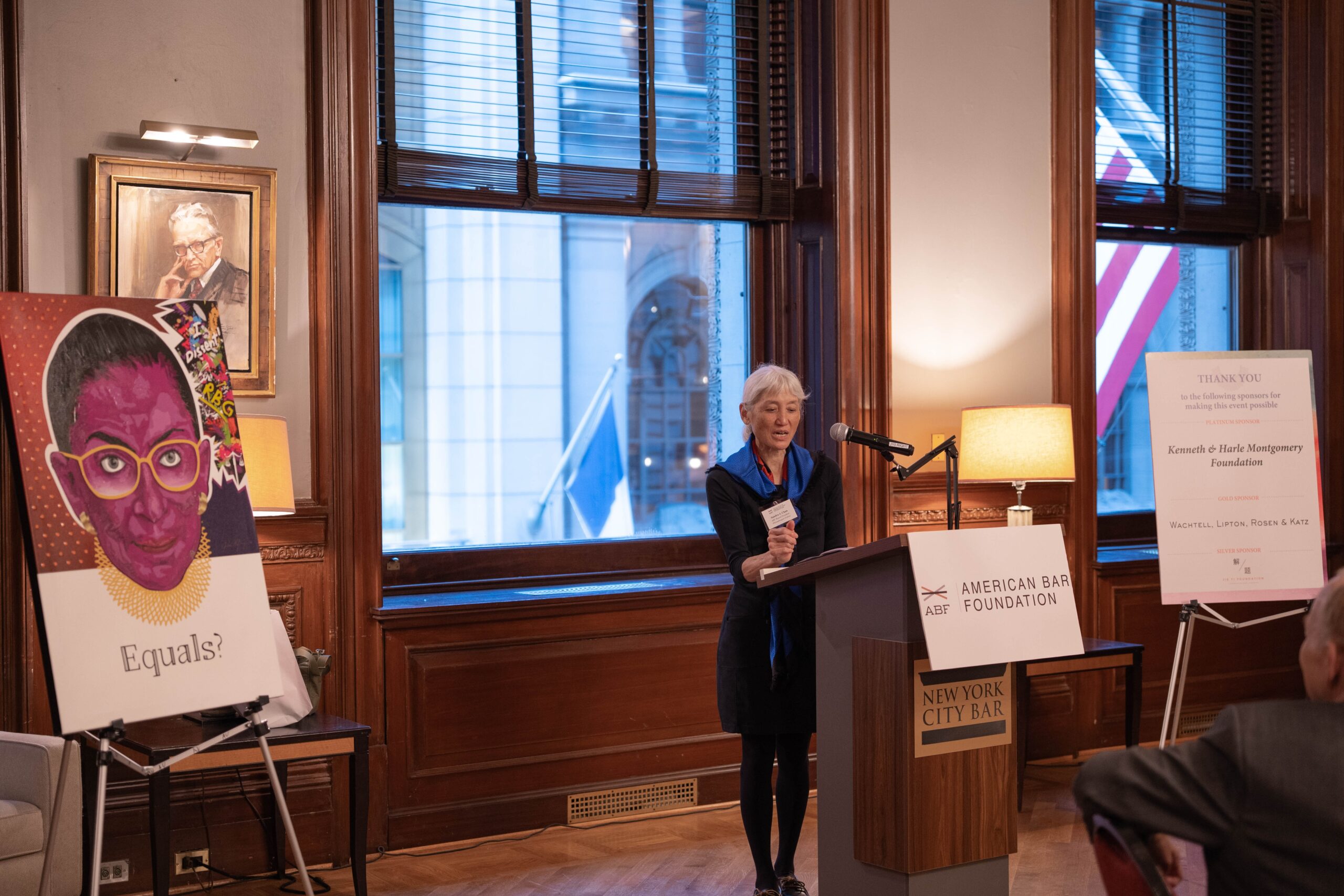
The night’s program began with Sandra J. Chan, ABF President, who introduced the event and thanked sponsors the Kenneth & Harle Montgomery Foundation, Wachtell, Lipton, Rosen & Katz, and the Jie Ti Foundation. Michael H. Byowitz’s, ABF Vice President, then introduced Byrant Garth, Interim Executive Director of the ABF. Garth emphasized the ABF’s commitment to producing empirical research which advances a more just and equitable future and reflected on Ginsburg’s contributions to the ABF. “She was one of the people who turned the ABF into a world class institution,” he said.
Garth recounted how Ginsburg’s questioning was key in the development of the ABF’s uniquely interdisciplinary research program during her time as a board member. “She asked the same kinds of tough questions that she asked when she was on the bench,” he said, noting that she brought a needed “rigor” that reshaped the ABF’s culture and helped the research program thrive.
Garth also highlighted some of the researchers who have received support from the RBG fund, including Rebbeca Sandefur and Shari Seidman Diamond. Sandefur received a MacArthur “Genius” Fellowship in 2018 for her research on access to justice in low-income communities. Diamond is a prominent scholar in the areas of jury processes and legal decision-making. “Our kind of research is essential to informing policy, strengthening instructions, and advancing justice,” Garth said.
Carrying Forward Ginsburg’s Values
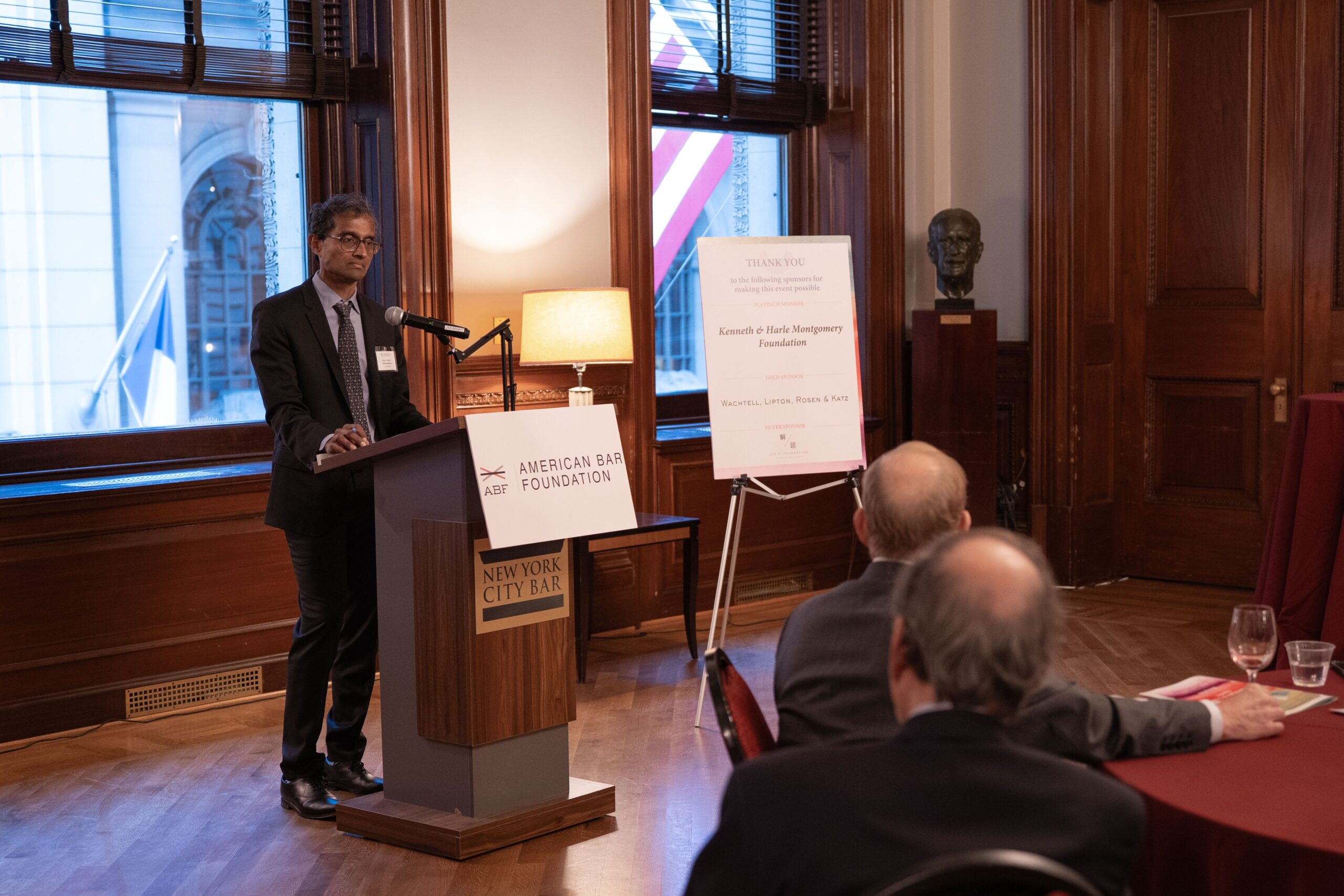
Garth introduced the honorable Arun Subramanian. Subramanian is a US District Judge on the United States District Court for the Southern District of New York. He is a Life Fellow of the ABF and served as a clerk for Ginsburg when she was an Associate Justice of the Supreme Court.
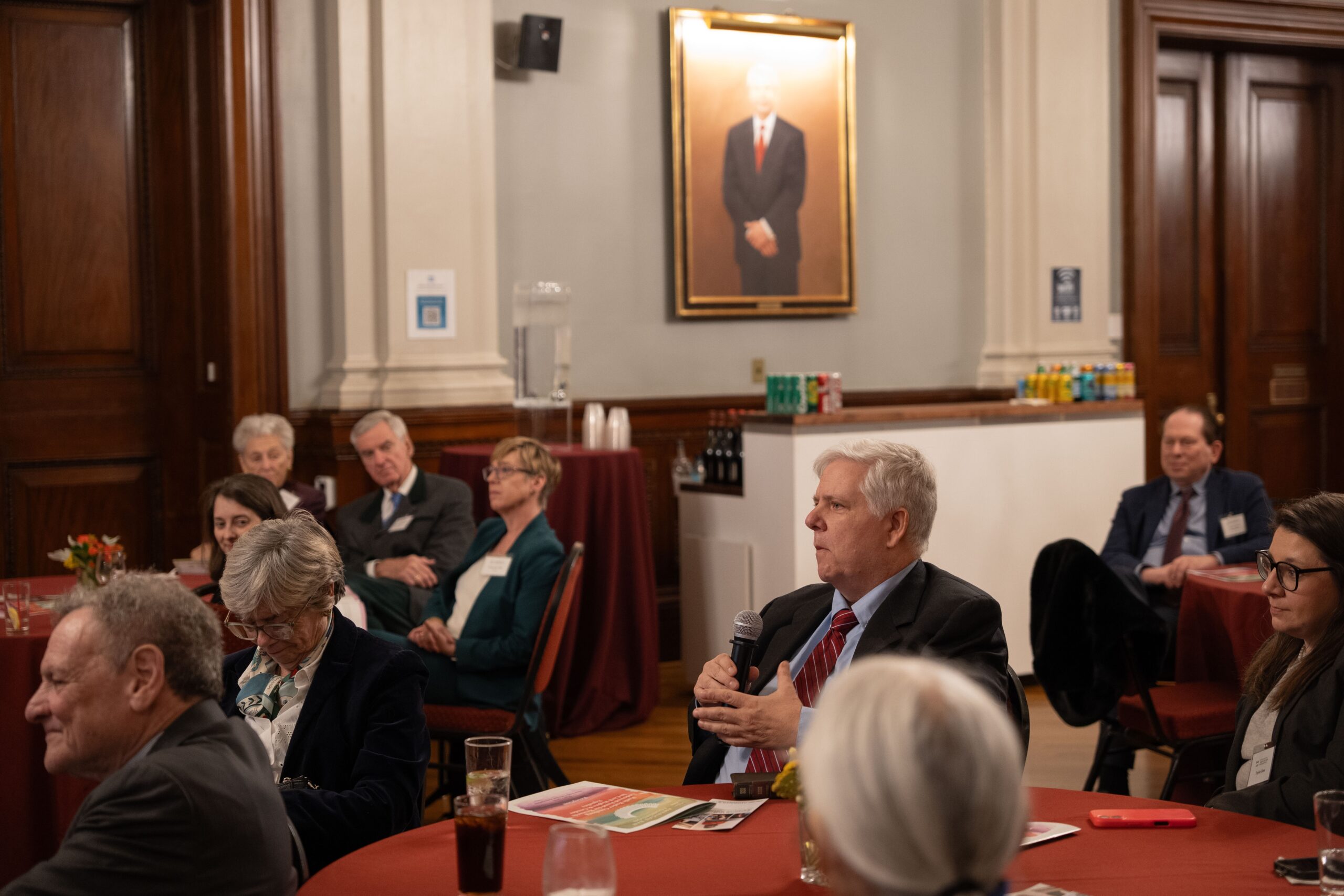
Subramanain reflected on his experiences clerking for Ginsburg almost two decades ago and spoke to how he has tried to follow her example throughout his career. “Justice Ginsburg spent her life pursuing justice with discipline, persistence, and courage,” he said. “She understood something that we often forget about the law, that some of the most important fights are not won right out of the gate.”
Subramanian witnessed this during his clerkship. In 2007, the Supreme Court heard the case Ledbetter v. Goodyear Tire & Rubber Co. The case concerned Lily Ledbetter. Across her decades-long career at Goodyear tire, Ledbetter received more negative evaluations and fewer pay raises than men working at the same plant. At the time of her retirement in 1998, she made far less than the lowest-paid man she worked with. That same year, she sued Goodyear for pay discrimination.
While a lower court found in favor of Ledbetter, the Supreme Court found that employers could not be sued for race or gender pay discrimination if the claims were based on decisions made by the employer 180 days or more before the claim. They did not rule on the worthiness of Ledbetter’s claims about discrimination, only finding that she had filed her claims too late.
Subramanian witnessed Ginsburg announcing her dissent from the bench, an act Justices on the Supreme Court reserve for the most serious cases. “At the close of her dissent,” Subramanian reflected, “Justice Ginsburg said that the ball lies in Congress’s court. The Courtroom was completely silent, and the nation was listening.”
In 2009, the first bill President Obama signed into law was the Lilly Ledbetter Fair Pay Act. The act states that the statute of limitations for filing a lawsuit related to pay discrimination begins with each new paycheck affected by the discrimination, opening the door for more people facing pay discrimination to seek justice.
The story, for Subramanian, reflects Ginsburg’s lifelong tenacity in perusing justice—her understanding that “losing a case did not necessarily mean losing a cause.”
“All I can do now, all any of us can do now is try to carry forward the values she lived by: rigor, perseverance, humility, and faith that the law can bend toward justice if enough people are willing to push it there,” Subramanian said.
A Tribute to Ginsburg’s “pearls of wisdom”
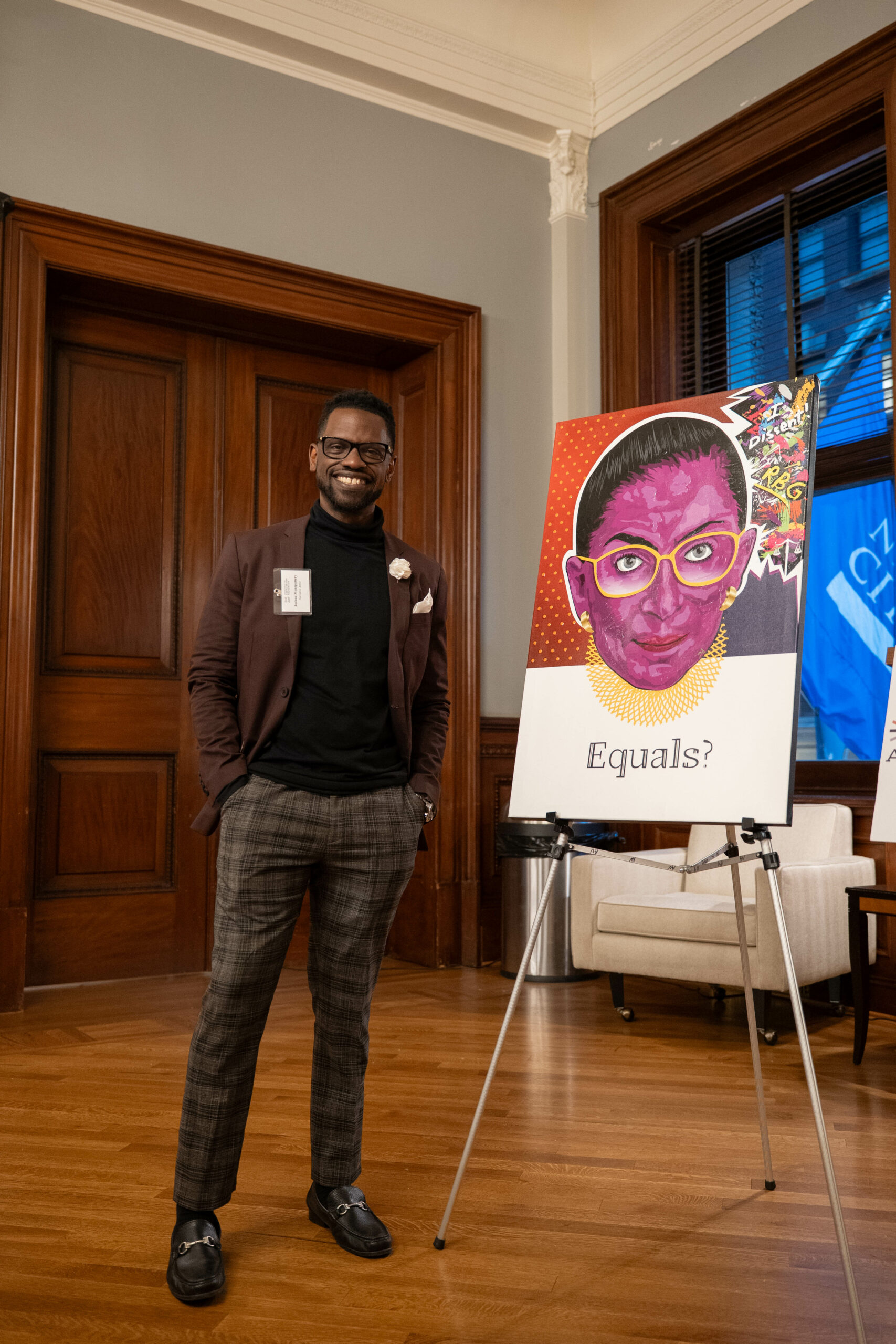
Subramanian’s remarks were followed by a question-and-answer session. The conversation touched on Ginsburg’s judicial approach and about her relationships with other Justices during her time on the Court. Following the audience questions, Bryant Garth introduced Joshua Montgomery, who generously donated a painting to the ABF to commemorate Ginsburg’s legacy.
Montgomery is a visual artist based in Texas. Standing beside his painting, Montgomery explained some of the symbolic elements he included in the work to reflect Ginsburg’s story and her wide impacts on American culture. The shape of Brookyln is hidden as a highlight on Ginsburg’s face in the portrait, and eighty-seven “pearls of wisdom” on the left side of the canvas represent the years of her life.
The title of the portrait, Equals?, also takes on a layered meaning. Montgomery explained that, on one hand, the title questions if the goal of gender equality which Ginsburg fought for has truly been achieved in 2026. On the other hand, it is a question about Ginsburg’s fight for equality with her peers.
“She was a huge success, and she faced discrimination. She faced people putting roadblocks in her way simply because she was a woman,” Montgomery said. If she were able to overcome so much and do more in her career than many of the men who put obstacles in her way, Montgomery wondered, is it fair to regard Ginsburg merely as their equal? “They’re not her equal, that’s not the case,” he said.
The event’s Platinum Sponsor was the Kenneth & Harle Montgomery Foundation. The Gold Sponsor for the event was Wachtell, Lipton, Rosen & Katz. The Silver sponsor was the Jie Ti Foundation. The ABF thanks our Platinum, Gold, and Silver sponsors for their support of this event, and graciously recognizes all of those who have supported the RBG Fund throughout its existence.
###
About the American Bar Foundation
The American Bar Foundation (ABF) is the world’s leading research institute for the empirical and interdisciplinary study of law. The ABF seeks to expand knowledge and advance justice through innovative, interdisciplinary, and rigorous empirical research on law, legal processes, and legal institutions. To further this mission the ABF will produce timely, cutting-edge research of the highest quality to inform and guide the legal profession, the academy, and society in the United States and internationally. The ABF’s primary funding is provided by the American Bar Endowment and the Fellows of the American Bar Foundation.