
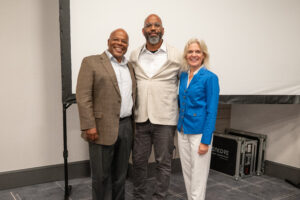
The ABF Fellows CLE Program, held July 31 during the 2026 ABA Annual Conference, examined the lasting consequences of mass incarceration and why, for many people, the legal and social effects of a conviction continue long after a prison sentence has ended. The program, “The Afterlife of Mass Incarceration,” featured ABF Research Professor and MacArthur “Genius” Reuben Jonathan Miller, also Chancellor’s Professor of Sociology at the University of California, Berkeley, in conversation with Calvin Duncan, an Innocence Project exoneree, founder and director of Light of Justice, and the author of The Jailhouse Lawyer. Moderated by National Fellows Chair Jennifer L. Parent, the discussion brought together empirical research and lived experience to explore how incarceration shapes individuals, families, and communities—and how the legal profession can respond.
Opening the program, Parent observed that for many people, “life after prison is its own form of prison,” setting the stage for a conversation about the lasting legal, economic, and social consequences of incarceration.
The Afterlife of Mass Incarceration
 Miller began by placing mass incarceration in social context, drawing on research that became his 2021 book, Halfway Home: Race, Punishment, and the Afterlife of Mass Incarceration. He described the dramatic expansion of incarceration in the United States beginning in the 1970s, when the number of people held in American jails and prisons grew from roughly 300,000 to more than two million. He also emphasized racial disparities that accompanied that expansion, noting that Black Americans are five times more likely to be incarcerated than white Americans and receive longer sentences for similar offenses.
Miller also encouraged the audience to think beyond the approximately two million people currently incarcerated in US prisons. Millions more remain on probation or parole or continue to live with the consequences of a criminal record. Citing research showing that some eighty million Americans have a criminal record, Miller argued that incarceration is only one part of a larger system. “We’ve inaugurated a vast carceral network that touches almost every American,” Miller said, noting that half of all Americans have a loved one who has been incarcerated.
The consequences of that system extend well beyond the end of a prison sentence. Miller’s research examines how people with criminal records continue to encounter restrictions on employment, housing, public benefits, civic participation, and family life. Tens of thousands of laws, policies, and administrative sanctions across the country impose restrictions, creating barriers that persist years after a person has served their sentence: “What I suggest is that this is the legal production of vulnerability.”
Lived Experience and the Fight for Justice
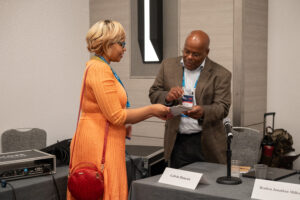 Duncan’s story illustrates the realities Miller’s research seeks to understand. Wrongfully convicted at age nineteen, Duncan spent more than twenty-eight years in prison before his release in 2011 and eventual exoneration a decade later. While incarcerated, he became what is known as a “jailhouse lawyer,” helping hundreds of fellow prisoners navigate a legal system that often left them without legal representation after their appeals had been exhausted.
Rather than setting out to become an advocate, Duncan explained that he stepped into the role because so many incarcerated people had nowhere else to turn for legal assistance. With limited formal education and no access to traditional legal resources, he taught himself the law, studying court decisions and legal principles in an effort to understand his own case and help others facing similar barriers. “It was my mission to take this powerful tool to help people that could not help themselves,” Duncan said, describing the journey that ultimately led him to earn his law degree at age sixty. His memoir, The Jailhouse Lawyer, recounts that journey.
Duncan later served as a clerk of court in Louisiana, seeking to address some of the same barriers to justice that he had experienced firsthand. Today, he leads Light of Justice, a nonprofit organization dedicated to expanding access to justice for incarcerated people and those returning to their communities.
A Call to Action for the Legal Profession
The discussion closed with a call to action for members of the legal profession. Duncan urged lawyers and judges to recognize the role of incarcerated people who work to expand access to justice from inside the system, often without formal training or resources. “The jailhouse lawyers are your brothers and sisters,” Duncan said. “We’re litigating the same issues without education, with trauma.” He encouraged members of the legal profession to view supporting access to courts and legal resources as part of their responsibility as lawyers: “My request to you all is, we shouldn’t have to be fighting these battles alone.”
Miller closed the discussion by emphasizing that meaningful change can happen at every level. “We’re looking at a giant American problem,” he said. “[But] it’s a giant American problem that can change, and it can change from whatever point you have influence.” For lawyers, he said, that means standing alongside people who need the power of the law. He also encouraged legislators, employers, and community organizations to consider how they can reduce barriers faced by people with criminal records. “The lesson from today is that change is possible,” Miller said. “Small-scale change and massive change—they’re all possible—and I think we could all dig in.”
Event Audio Recording Now Available
###
About the American Bar Foundation
The American Bar Foundation (ABF) is the world’s leading research institute for the empirical and interdisciplinary study of law. The ABF seeks to expand knowledge and advance justice through innovative, interdisciplinary, and rigorous empirical research on law, legal processes, and legal institutions. To further this mission the ABF will produce timely, cutting-edge research of the highest quality to inform and guide the legal profession, the academy, and society in the United States and internationally. The ABF’s primary funding is provided by the American Bar Endowment and the Fellows of The American Bar Foundation.