
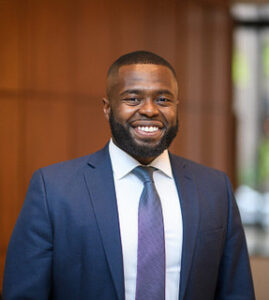
 Shaun Ossei-Owusu has been named the William H. Neukom Fellows Research Chair in Diversity and Law for the 2026–27 academic year. Ossei-Owusu is a Presidential Professor of Law at the University of Pennsylvania Carey Law School, where he teaches courses on criminal law, the legal profession, antidiscrimination law, the welfare state, and the business of law firms.
“I’m incredibly excited to be back in community with the scholars at the American Bar Foundation. It’s been a place that has been instrumental to my intellectual and professional development for most of my academic career. All of my big projects are indebted to the feedback and mentorship from the scholars there. I’m looking forward to crafting new figurative and literal chapters this year,” said Ossei-Owusu. He has longstanding ties to the ABF, having received the LSA/ABF Law and Social Science Dissertation and Mentoring Fellowship in 2010. That fellowship helped support the research at the foundation of his second book, Many Hands for Justice: Legal Aid and the Making of America, which will be published by Princeton University Press in spring 2027.
The Neukom Chair is named for William H. Neukom, a Philanthropist Fellow of the ABF and former ABF Board member, who passed in 2025. In 2014, Neukom made pivotal lead investments to establish the William H. Neukom Fellows Research Chair in Diversity and Law. The Neukom Chair is a yearlong visiting position that supports an exceptional scholar conducting research on legal and social issues contributing to inequities in the law and legal processes.
Ossei-Owusu’s scholarship examines the relationships between law, legal institutions, inequality, and the legal profession. Drawing on legal history, law and society scholarship, and doctrinal analysis, he examines how law both reflects and produces social conflict. His first book, Law on Trial: An Unlikely Insider Reckons with Our Legal System, published by Norton in 2026, considers how lawyers, through legal education and practice, are implicated in social inequality. In spring 2025, Ossei-Owusu hosted a workshop based on Law on Trial at the ABF with scholars from the ABF, Northwestern, and the University of Chicago, underscoring the role the ABF has played in supporting and shaping his research. During his time as the Neukom Chair, Ossei-Owusu will work on portions of his next two projects.
The first project is focused on legal cynicism—a term used by sociologists to describe the belief that legal institutions, typically police and courts, are ineffective, corrupt, and illegitimate. Ossei-Owusu’s project expands the concept beyond its traditional focus by examining legal cynicism as a broader phenomenon that has taken different forms across American history. Drawing on political and social movements on both the left and the right, the project examines how such distrust has shaped struggles over rights. It also considers what these patterns can tell us about contemporary political polarization and crises of legal authority.
The second project takes a more literary approach to law and society scholarship. It explores how storytelling and narrative can offer distinctive insights into how law operates and inequality is experienced in the present moment of profound social change. By broadening the range of lives represented in legal fiction and scholarship—including racial minorities, poor whites, rural residents, people with disabilities, and immigrants—the project makes two core moves. The first is epistemological and asks what a broader range of narratives can reveal about law that conventional legal analysis may overlook. The second is more public-facing and considers how storytelling can make law more legible to broader audiences in a rapidly changing information environment.
“Both projects are interdisciplinary and ask how we might understand law differently at a moment when our relationships with legal institutions, one another, and information are all changing,” said Ossei-Owusu. “I can’t think of a better place to develop these projects than the ABF.”
“I am delighted to welcome Professor Ossei-Owusu as this year’s Neukom Chair,” says Jennifer Parent, Chair of the ABF Fellows. “His scholarship speaks directly to the questions at the heart of the ABF’s mission—how law shapes, and is shaped by, the pursuit of equality and justice. The Fellows look forward to the contributions he will make to our community.”
###
About the American Bar Foundation
The American Bar Foundation (ABF) is the world’s leading research institute for the empirical and interdisciplinary study of law. The ABF seeks to expand knowledge and advance justice through innovative, interdisciplinary, and rigorous empirical research on law, legal processes, and legal institutions. To further this mission the ABF will produce timely, cutting-edge research of the highest quality to inform and guide the legal profession, the academy, and society in the United States and internationally. The ABF’s primary funding is provided by the American Bar Endowment and the Fellows of the American Bar Foundation.