• Skip to primary navigation
  • Skip to main content

ABF.

Research Advancing Justice

  • Facebook
  • Twitter
  • YouTube
  • ABF Fellows
  • Donate
  • Research
    • Research
      • Learning and Practicing Law
      • Protecting Rights and Accessing Justice
      • Making and Implementing Law
      • See Recent Research
    • Other Work
      • ABF Newsletter: Researching Law
      • ABF Podcast: Whose Law is it Anyway?
      • Access to Justice Research Initiative
      • Law & Social Inquiry
      • Featured Researcher
  • People
  • Programs
    • Faculty Scholars
    • Postdoctoral Fellowships
    • Doctoral Fellowships
    • Undergraduate Fellowships
  • Giving
    • Impact Funds
      • The Ruth Bader Ginsburg Endowed Fund for Research in Civil Rights and Gender Equality
      • The William C. Hubbard Law & Education Conference Endowment
      • The William H. Neukom Fellows Campaign for a Research Chair in Diversity and Law
    • Donate
      • Leave a Legacy
      • Qualified Charitable Distribution (QCD)
  • News & Events
  • About
    • Board of Directors
  • ABF Fellows
  • Donate
  • FacebookTwitterYouTube
Home > Law & Social Inquiry

Law & Social Inquiry
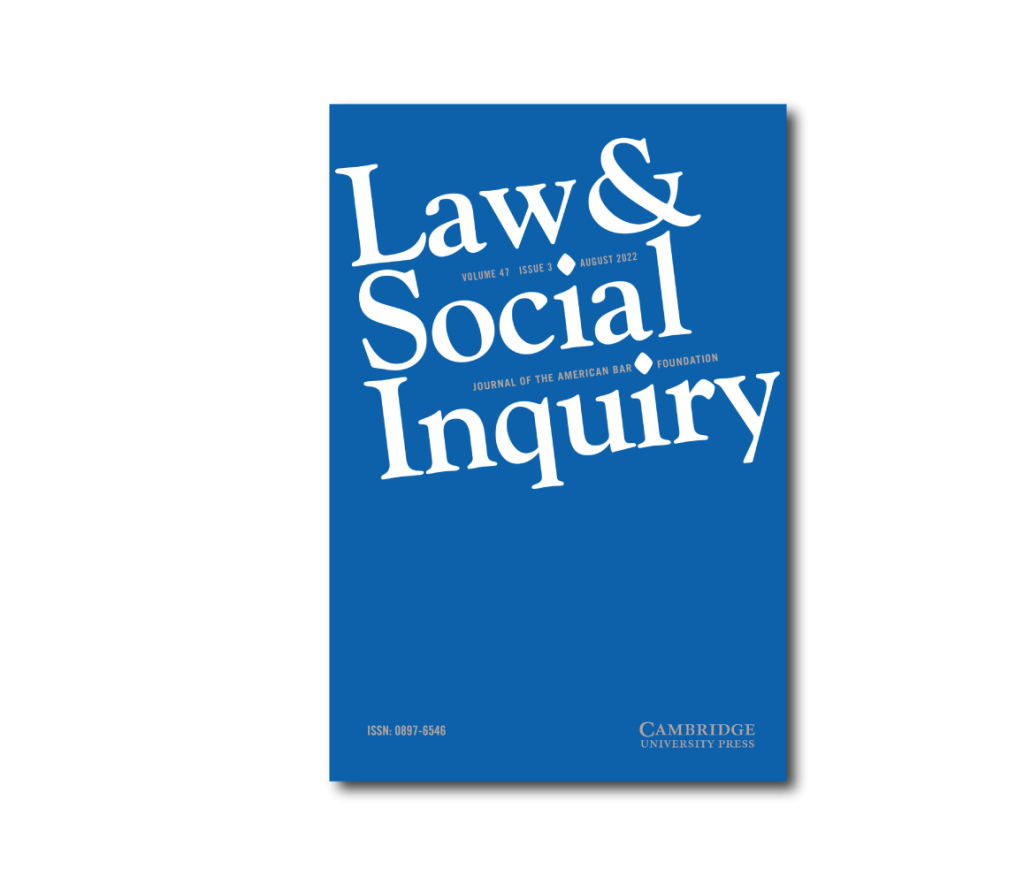
Law & Social Inquiry

The ABF sponsors Law & Social Inquiry (LSI), a multidisciplinary quarterly publication of original research articles and review essays that analyze law, legal institutions, and the legal profession from a sociolegal perspective.

LSI contributors examine law and society issues across multiple disciplines, including anthropology, criminology, economics, history, philosophy, political science, sociology, and social psychology. The journal’s combination of empirical and theoretical scholarship and critical appraisal of the latest sociolegal scholarship makes LSI an indispensable source for legal scholars and practitioners.

For more information and submission guidelines, please visit the journals’ page at Cambridge University Press.

Follow us on Bluesky @lsijournal.bsky.social.

Explore Current Issue
2026 Graduate Student Paper Competition Winner

"Registries, Records, and the Making of Emancipation in Pennsylvania”

Laura Nelson

“Registries, Records, and the Making of Emancipation in Pennsylvania” examines how Pennsylvania’s 1780 Gradual Abolition Act transformed slavery and freedom into matters of documentation. Drawing on county registries, Pennsylvania Abolition Society records, and historical correspondence, Nelson argues that emancipation unfolded through evolving documentary practices rather than legislative decree alone. Her work shows how enslaved and free Black Pennsylvanians navigated a system in which freedom was often established through the absence of records, while documents became critical tools for asserting and preserving claims to liberty.

Nelson is a PhD candidate in the Department of History at Princeton University.

View a List of Past Recipients Here.

Editorial Staff

All inquiries regarding the journal or submission criteria can be directed to lsi@abfn.org.

Editorial Board

Full Name University State Country

International Book Essay Editorial Panel

Full Name University Sort Name Country

  • About
  • People
  • Careers
  • For Media
  • Logos & Colors
  • Annual Report
    • Form 990
  • ABF Fellows
  • Research
  • Learning and Practicing Law
  • Protecting Rights and Accessing Justice
  • Making and Implementing Law
  • Other Work
  • ABF Newsletter: Researching Law
  • ABF Podcast: Whose Law is it Anyway?
  • Access to Justice Research Initiative
  • Law & Social Inquiry
  • Programs
  • Faculty Scholars
  • Postdoctoral Fellowships
  • Doctoral Fellowships
  • Undergraduate Fellowships
  • Giving
  • Impact Funds
  • Leave a Legacy
  • News & Events

Sign up for ABF News:

  • This field is for validation purposes and should be left unchanged.
  • Facebook
  • X
  • YouTube
Logo
Research Advancing Justice
  • Contact Us
  • Contact the Fellows
  • For Media
  • Privacy Policy
American Bar Foundation
750 North Lake Shore Drive, Fl. 4, Chicago, IL 60611-4557
© 2026 American Bar Foundation
Any opinions, findings, and conclusions or recommendations expressed in ABF publications are those of the author(s) and do not necessarily reflect the views of the American Bar Foundation or the American Bar Association. The AMERICAN BAR FOUNDATION, ABF, and related seal trademarks as used by the American Bar Foundation are owned by the American Bar Association and used under license.