
From University of Chicago Law Review:
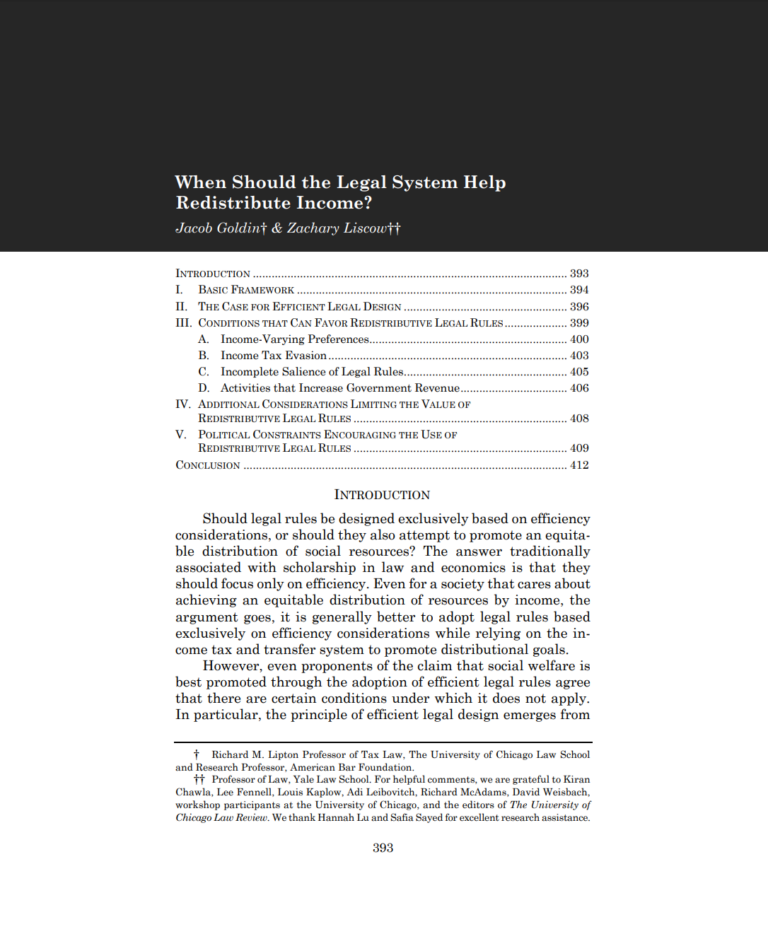
This Essay considers when legal rules should be efficient and when they should not. Focusing on conditions that can cause the socially optimal legal rule to diverge from the efficient legal rule—i.e., the legal rule that would be optimal absent distributional considerations. These conditions include preferences or behaviors that vary over the income distribution, imperfect salience of the incentives generated by legal rules, income tax evasion or avoidance, and regulated activities that generate income. Like the general argument for efficient legal rules, all of these exceptions draw on existing results from the economics literature on optimal taxation. The goal of this article, is to translate these arguments to settings where the question of interest relates to the design of a legal rule rather than, say, the design of a commodity tax. In particular, the article seeks to clarify the types of arguments that can support the adoption of inefficient legal rules when income taxation is available as a policy tool.